
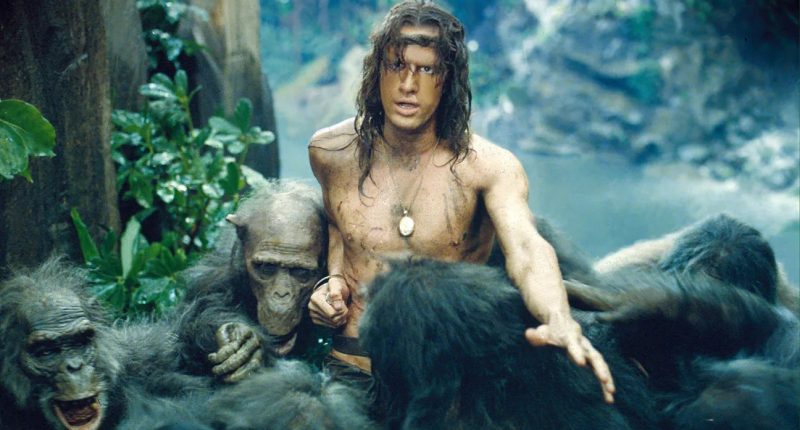
Christopher Lambert as the Ape-Man in the Epic Drama Greystoke: The Legend of Tarzan, Lord of the Apes
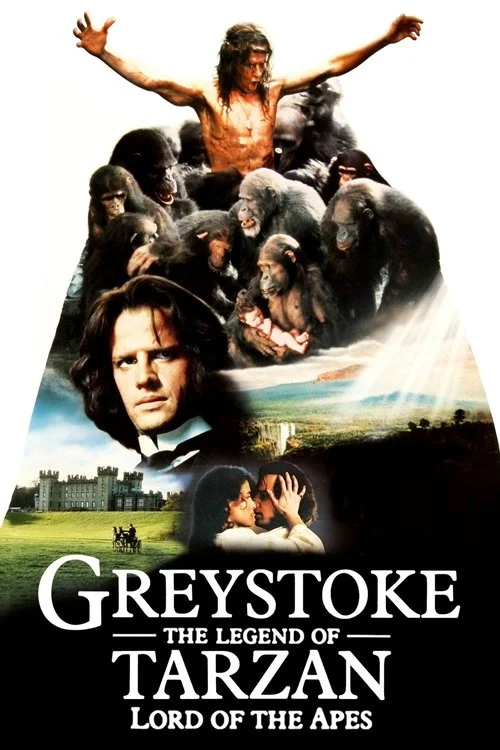
Greystoke: The Legend of Tarzan, Lord of the Apes is one of those adaptations of Edgar Rice Burroughs’ classic that refuses to coast on the familiar jungle-adventure template. Instead of a carefree hero swinging effortlessly from vine to vine, the film offers a more serious, more dramatic portrait of a man split between two worlds. That sober perspective is precisely why this version remains, even today, one of the most distinctive Tarzan films ever made.
The story’s brutal beginning is well known: the ship carrying the parents of young John Clayton is wrecked off the African coast. The child who should have grown into an English aristocrat and heir to a noble lineage is raised instead in the equatorial jungle among apes. He becomes a being who belongs fully to neither human society nor the animal world. The film treats this premise with unusual sensitivity—presenting Tarzan not as an untouchable legend, but as a person shaped by pain, instinct, and a relentless search for identity.
Christopher Lambert as an ape-man with a human soul
The film’s undeniable centerpiece is Christopher Lambert, cast as Tarzan at the very start of his major career. That early-career rawness works in the role’s favor: his performance feels immediate and unpolished in a way that suits a man raised beyond civilization’s rules. Lambert’s Tarzan is neither a refined romantic icon nor a conventional adventure hero. He is an ape-man in the most convincing sense—physically and psychologically marked by life outside the human world.
Lambert gives Tarzan feral energy, restless physicality, and a surprising fragility. His gaze, his movement, and his comfort with silence suggest a creature who understands the jungle better than spoken language. When Tarzan collides with Europe, Lambert doesn’t play it as simple confusion; he plays a deep internal fracture. This is not a man who can easily “return” to his origins. Civilization feels foreign, constricting, and at times brutally indifferent.
That approach separates the film from many earlier adaptations. Some of the best-known Tarzans in screen history include Johnny Weissmüller, as well as Glenn Morris, Lex Barker, and Gordon Scott—versions defined by charm and breezy adventure. Lambert, by contrast, delivers something tougher and more psychologically layered. His Tarzan isn’t a myth cast in bronze; he’s a man who must first figure out who he is.
Jane and a world that attracts—and wounds
Andie MacDowell plays Jane, and her presence is essential. It was effectively her film debut, yet she brings gentleness, curiosity, and a civilizational viewpoint that is both alluring and dangerous to Tarzan. Jane isn’t merely a romantic accessory; she becomes a bridge between two radically different realities—between the jungle’s natural order and society’s expectations.
Their relationship is handled with more care than is typical for adventure films. It isn’t simply “beauty meets the wild man,” but a meeting of two ways of living. Jane recognizes humanity where others see only an oddity. Tarzan, through her, glimpses a world that is biologically his—yet emotionally distant, almost unreachable.
Hugh Hudson’s direction and the film’s epic tone
Director Hugh Hudson, fresh off the Oscar-winning Chariots of Fire, gives Tarzan an unexpectedly sweeping—and quietly melancholic—shape. His background in documentary work, editing, and advertising can be felt in the film’s emphasis on imagery, rhythm, and atmosphere. The jungle here isn’t a mere backdrop for action; it’s a living environment that molds the characters and defines the film’s emotional weight.
Hudson builds the narrative around contrast: untamed nature on one side, polished English society on the other—complete with its rules, rituals, and demands. The clash never feels superficial. The film asks an uncomfortable question: is a return to one’s “roots” even possible when a person has been formed, since childhood, by something entirely different than family name, tradition, and status?
Greystoke: The Legend of Tarzan, Lord of the Apes isn’t only an African jungle adventure—it’s also a striking drama about identity, origin, and the cost of civilization.
A strong supporting cast and critical recognition
Beyond the leads, the supporting cast deserves attention. The film features Ian Holm and veteran British actor Ralph Richardson, for whom the role of Lord Greystoke became his final film appearance. Richardson sadly did not live to see the movie’s theatrical release, which lends his participation a poignant resonance in retrospect. His performance earned the New York Film Critics Circle Award for Best Supporting Actor—further proof of how carefully the film was cast.
The production received three Academy Award nominations and ultimately won a BAFTA for makeup. The makeup and overall design are crucial to the film’s impact: Tarzan’s look, his physical transformation, and the tangible authenticity of the environment all reinforce the sense that we’re watching a real human being raised outside civilization—not a cinematic novelty.
Why Lambert’s Tarzan is still worth your time
Christopher Lambert later became widely known for films like Highlander, but his Tarzan remains one of the most intriguing showcases of his talent. He combines physical expressiveness with inner turmoil to create a hero that lingers in the mind. This ape-man is neither a caricature nor an idealized legend—he’s believable, tragic, and, in many ways, surprisingly modern.
As a result, Greystoke: The Legend of Tarzan, Lord of the Apes stands out not only among Burroughs adaptations, but within the adventure genre as a whole. It delivers grand imagery, committed performances, and an emotional depth that reaches beyond the usual “jungle hero” narrative. And it’s Lambert—through intensity, physicality, and the ability to communicate a life story without words—who ultimately holds the film together: a man born for one world, raised by another.
Source: imDb, MetaCritic, Wikipedia




Comments 0
No comments yet. Be the first to share your thoughts!
Leave a Comment