
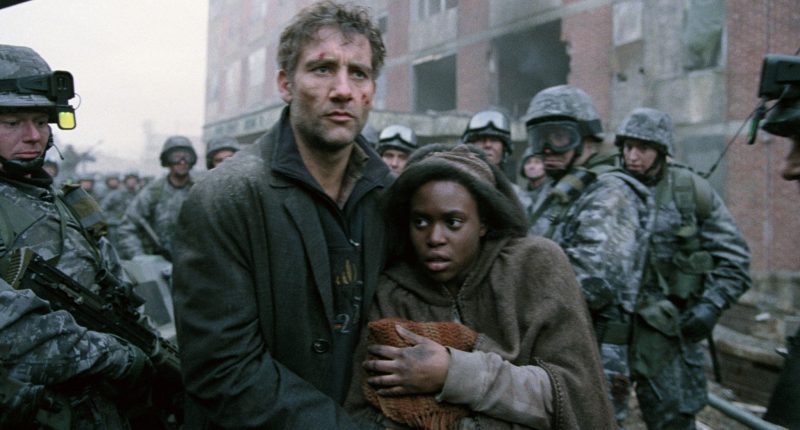
Children of Men (2006) remains one of the most striking dystopian films of the 21st century. Director Alfonso Cuarón imagined a near future in which humanity has gone eighteen years without a single birth. At the center is Theo Faron, a weary civil servant who is unexpectedly pulled into a dangerous mission: escorting the first pregnant woman in nearly two decades to safety. The film earned admiration not only for its urgent story, but also for its unnervingly realistic style—its long, immersive takes, its tactile sound design, and its suffocating picture of a society coming apart at the seams.
What ended up on screen, however, was the result of a long—and often complicated—development process. The film is based on P. D. James’s 1992 novel, whose screen rights were acquired back in the 1990s. For years, multiple screenplay versions failed to unlock a satisfying approach, and the project stalled. Producer Marc Abraham believed the material required a director with a singular perspective, so the scripts waited—sometimes for years—until the right voice arrived.
How a Literary Adaptation Became a Contemporary Nightmare
The turning point came when Abraham saw Cuarón’s Y Tu Mamá También. He sensed a filmmaking sensibility that could make Children of Men feel alive rather than “adapted.” Cuarón himself was initially drawn more to the premise than to the existing Hollywood draft. After the events of September 11, his relationship to the project changed: dystopia, he concluded, wasn’t a far-off tomorrow—it was a condition already creeping into everyday life. That idea became the film’s organizing principle.
The screenplay evolved dramatically over time. Some early versions leaned into a road-movie structure; others searched for a classic romantic framework, even taking cues from Casablanca. Theo was conceived as a disillusioned man who once believed in ideals but no longer had the will to fight. That specific shape of the protagonist—the exhausted believer—helped convince Cuarón the story was worth claiming as his own.
Casting That Gave the Characters Their Humanity
Well-known Hollywood names circled the lead at different points, but the role ultimately went to Clive Owen. Owen initially wasn’t sure he was the right fit for Theo, yet he accepted largely out of trust in Cuarón’s talent. The result is a performance that avoids action-hero swagger: Theo feels like an ordinary man being pushed forward by events he can barely control.
Just as crucial is Kee, the young refugee who becomes the first pregnant woman in years. Clare-Hope Ashitey landed the role in an almost accidental stroke of luck during acting classes in London and began filming soon after her audition. Late in the process, Cuarón changed course and asked her to speak with an African accent. Ashitey also brought a personal note to the film by singing a Ghanaian lullaby in one scene—something she knew from her mother.
In the film, Kee is a Black migrant—unlike in the novel. The change was deliberate. Cuarón used it to underline a symbolic idea: the future of humanity returning to Africa, where many scientific theories place humanity’s origins. It also avoided turning hope into a story centered on a privileged white woman.
Powerful Supporting Roles and Carefully Chosen Influences
Julianne Moore does not play the pregnant woman—she plays Julian, a leader within the activist group known as the Fishes. Michael Caine, as Jasper Palmer, delivers one of the film’s most memorable supporting turns. He shaped Jasper with clear echoes of John Lennon—voice, mannerisms, even the round glasses. Chiwetel Ejiofor and Charlie Hunnam round out the resistance figures, embodying how quickly a cause can slide from conviction into control—and from survival into opportunism.
London 2027: A Believable Collapse of Civilization
The opening is among the film’s most effective sequences: Theo steps out of a café onto a London street, and seconds later an explosion tears through the scene. It plays like a single unbroken shot, but it was actually built by combining material from two shooting days and finishing it with digital work. The filmmakers added not only the blast effects, but also the small environmental signals—advertising, government messaging, and propaganda—that immediately define the shape of this repressive society.
Cuarón insisted the future should not look like polished sci-fi. Production design and costumes were tasked with creating the opposite of Blade Runner: a world that feels worn down, dirty, improvised, and painfully familiar. The team drew from real imagery of wars and detention sites—Guantánamo, Abu Ghraib, Chernobyl, and the Northern Ireland conflict among them. That grounding in reality is a major reason the film still feels so plausible.
Camera and Sound as the Film’s Primary Weapons
A key reason Children of Men hits so hard is the work of cinematographer Emmanuel Lubezki. The long takes aren’t just technical showpieces—they function as a method of forcing the viewer to inhabit the panic and confusion of the world. The famous ambush-in-the-car sequence (in which Julian is killed) required a specially modified vehicle and a complex camera rig that could glide inside the cabin in multiple directions. Though it feels seamless, it is built from several precisely stitched components.
Sound design was just as essential. The team bent typical mixing conventions, letting sound move with the camera rather than sitting neatly “on top” of the image. Gunshots, explosions, and distant chaos don’t feel like accompaniment; they feel like physical space. The result is a near-documentary intensity that makes the film’s violence harder to compartmentalize.
Symbols, References, and Meaning Hidden in the Images
The film is layered with cultural, literary, and religious references. Even the title echoes a biblical psalm. The Fishes recall an early Christian symbol, and motifs of birth, redemption, and fragile hope recur throughout. Cuarón toned down the overt religiosity found in the novel, but he did not remove the spiritual undertones entirely.
Other meanings are embedded in the production design. In Nigel’s art collection, viewers can spot a Banksy piece, Picasso’s Guernica, and a nod to Pink Floyd’s Animals album cover—each widening the film’s themes of violence, state power, cultural memory, and civilizational decay. The repeated appearance of oranges foreshadows death, a well-known cinematic tradition associated with films like The Godfather.
Bexhill as a Mirror of History—and the Present
The film’s climax unfolds in Bexhill, transformed into a nightmarish refugee camp. The filmmakers shaped this world using real historical precedents—from Nazi concentration camps to the internment of Japanese Americans, and on to modern refugee crises. The imagery also contains unmistakable echoes of photographs associated with the torture of prisoners in Iraq. The intent is not empty shock, but a reminder that the film’s horror grows from documented history.
In Bexhill, Cuarón’s direction reaches full force. The extended final battle sequence took weeks to prepare and was punishing to repeat. One of the film’s most famous moments—blood splashing onto the lens—was unplanned. Cuarón initially wanted to stop the take, but the shot remained and became an indelible detail, as if the film itself had been wounded by what it witnessed.
The Birth of a Child—and a Fragile Hope
The birth scene is the film’s emotional core. At the last moment, Cuarón decided to stage it as a single continuous shot. Practical effects, prosthetics, and digital work were combined to make the newborn feel as real as possible. It was a gamble: if the baby looked artificial, the scene’s power would collapse. Instead, it becomes the point where the story reveals itself as more than a portrait of breakdown—it is also a cautious argument for beginnings.
Reception—and the Film’s Growing Importance
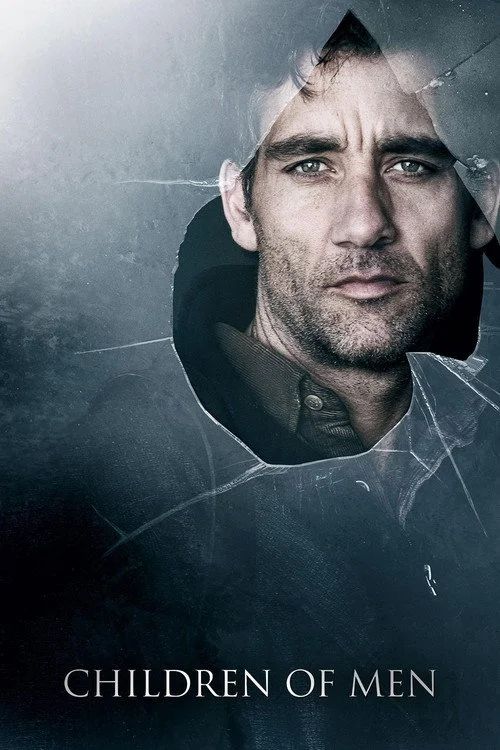
Although Children of Men earned critical acclaim and several Oscar nominations, it did not become a major box-office hit. Many argued the marketing missed the film’s essence by selling it primarily as an action-driven thriller centered on Clive Owen, rather than communicating the story’s bleak intimacy and political dread. Its U.S. release timing also worked against it.
Over time, its reputation has risen dramatically. Today it is frequently cited as one of the finest dystopian films of the modern era. Viewers and critics return not only for the filmmaking virtuosity, but because the world no longer feels like distant fiction. Children of Men is rare in how it fuses extraordinary craft with an uncomfortably precise vision of a society losing its humanity—while still, stubbornly, searching for a reason to hope.
Source: All the Right Movies, Rotten Tomatoes, Wikipedia




Comments 0
No comments yet. Be the first to share your thoughts!
Leave a Comment