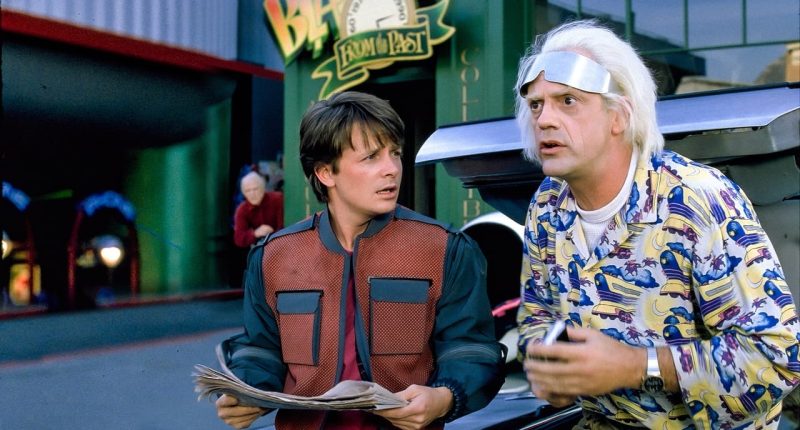
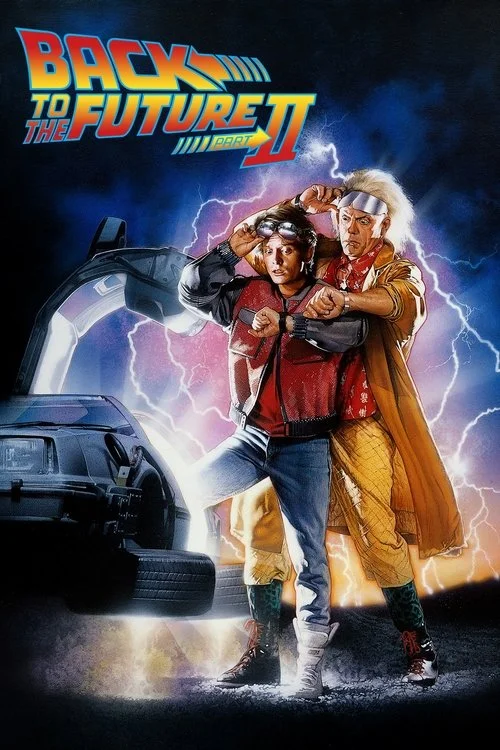
Back to the Future Part II ranks among the most daring Hollywood sequels of its era. While the 1985 original dominated theaters and became a full-blown pop-culture phenomenon, the 1989 follow-up chose the riskier route: it expanded the story into a knotty, multi-layered time-travel puzzle. Instead of repeating a proven formula, it bounced between several timelines—touring a then-imagined 2015, plunging into a bleak alternate 1985, and even revisiting key events from the first film from new angles. The result was a movie that demanded a lot from audiences—and even more from the people making it.
After the first film’s success, Universal pushed hard for a continuation. Director Robert Zemeckis and writer Bob Gale were wary of sequels that simply recycle old ideas, but the studio made it clear that another installment would happen regardless. Zemeckis and Gale agreed only on one crucial condition: Michael J. Fox and Christopher Lloyd had to return. For them, the franchise didn’t work without that pairing.
Then the scale grew even larger. Universal didn’t greenlight just one more film—it committed to two. Parts II and III were budgeted at roughly $40 million each and produced back-to-back, a major move for late-’80s Hollywood that foreshadowed the “shoot multiple sequels at once” strategy later used by other blockbuster trilogies.
Michael J. Fox under enormous pressure
By the time he stepped back into Marty McFly’s shoes, Michael J. Fox was already a proven star—and his paycheck reflected that far more than it had on the first film. But the return was anything but comfortable. Early in production he was still finishing the final season of Family Ties, filming the series during the day and the movie at night. The schedule left him severely sleep-deprived, echoing the punishing routine he’d endured during the original.
In a strange twist, Fox has said he didn’t even learn about the sequel through an official studio announcement. He noticed it when VHS releases of the first film began carrying a line suggesting the story would continue—prompting him to call his agent immediately.
Personal events also colored the experience. During production, Fox’s father died, and Fox later admitted he drew on small real-life mannerisms when playing an older version of Marty in 2015. At the same time, he became a father himself when his first son was born. Even a few throwaway moments came from his everyday life—such as the bit where Marty’s son picks pepperoni off a pizza, inspired by Fox’s own eating habits.
Biff Tannen in multiple forms—and endless hours in makeup
Thomas F. Wilson arguably faced one of the film’s toughest acting workloads. In Part II he didn’t just play the familiar Biff—he played a whole cluster of Biffs and Biff-adjacent characters: an elderly Biff in 2015, a powerful and corrupt Biff in the alternate 1985, a younger Biff in the 1950s, and Griff, the futuristic troublemaker. Each version required a distinct performance and a different physical transformation.
The makeup demands were brutal. For the older Biff, preparation could take up to six hours a day, meaning Wilson sometimes started his day around 3 a.m. Scenes where two versions of the same character share the screen were even more complicated: he would shoot one version, remove prosthetics, reset, and return to camera as the other.
To shape the alternate-timeline Biff, the filmmakers looked to real-world American tycoons. Bob Gale encouraged Wilson to study the behavior and expressions of wealthy power players, later acknowledging that Donald Trump was among the inspirations. It’s easy to see why: alternate Hill Valley’s Biff feels like a satirical monument to unchecked wealth and influence.
The George McFly controversy—and a lawsuit that changed the industry
One of the production’s biggest complications involved George McFly. Crispin Glover, who played George in the first film, did not return for the sequel. Accounts differ on exactly why, but the outcome was clear: no deal was reached. The production used unused footage from the first movie and cast Jeffrey Weissman for new material, styling him with makeup and staging choices designed to resemble Glover as closely as possible.
That decision sparked a major dispute. Glover objected to the use of his likeness without permission and sued Universal. The case ended in a settlement, but its ripple effect was enormous: the actors’ union pushed for tighter rules limiting a studio’s ability to replicate or imply an actor’s face or performance without consent. In the age of deepfakes, digital face replacement, and AI, the controversy now looks almost eerily ahead of its time.
Weissman, meanwhile, found himself in an awkward position on set, facing comments and comparisons to the original actor despite having little control over the circumstances. Over time, the tension faded, and his participation has been viewed more sympathetically within the franchise’s history.
2015 as a playground for ideas
A huge part of Part II’s enduring appeal is its vision of 2015—a world built from imagination, design experimentation, and clever brand collaboration. In the film’s futuristic Hill Valley, viewers see flying cars, video calls, wearable tech, self-adjusting clothing, and instant-food gadgets. Some predictions look charmingly wrong today; others landed surprisingly close to reality.
Designer Edward Eyth helped shape many of the future-tech concepts, including wearable communication devices reminiscent of modern smartwatches and the famous pizza hydrator. The “tiny pizza becomes a full-size pizza” moment wasn’t a digital trick—it was a practical effect achieved through precise timing and a simple prop swap inside the machine.
Real brands also appear throughout the future setting—Nike, Pepsi, Pizza Hut, Mattel, Texaco—and Zemeckis challenged them to imagine how their products and logos might look three decades ahead. That collaboration is one reason the film’s advertising details still feel playful and thoughtfully designed rather than generic.
The hoverboard—iconic, and completely fake
If Part II has a single object that became pure legend, it’s the hoverboard. Creating it required a patchwork of techniques. In some shots, Fox rode a standard skateboard. In others, actors were suspended on wires that were later removed with visual effects. For certain water-adjacent angles, mirror surfaces and carefully planned camera positions helped sell the illusion.
When performers were strapped into harnesses, their feet were fixed to the board, leaving them unable to simply step off between takes. Crew members often had to carry them from place to place. The now-famous hoverboard chase sequences were the product of physical strain, technical innovation, and meticulous post-production.
The hoverboard also spawned one of cinema’s most famous myths. Zemeckis once joked in a TV special that hoverboards were real, but kept off the market because parents considered them too dangerous. Plenty of viewers believed it, and Mattel reportedly received a flood of inquiries asking where to buy one.
Effects that pushed the limits of the era
Part II became a milestone for film technology. The story required scenes where actors play multiple versions of themselves within the same moving shot—something far beyond routine at the time. Simple split-screen methods weren’t enough because Zemeckis wanted camera movement. The solution was a computer-controlled motion system that could repeat the exact same camera path across multiple passes, allowing performances to be combined seamlessly.
That’s how Fox could appear at one dinner table as Marty, Marty Jr., and Marlene; how Lloyd could share the frame with a different-age Doc; and how Wilson could face himself as young and old Biff. It was a breakthrough that stunned audiences then and remains one of the era’s most impressive practical/optical hybrids.
The flying DeLorean was built with similar ingenuity. The production relied on multiple versions of the car—miniatures, hydraulic rigs, and specialized bodies for close-ups—each designed for a different type of shot. The “real” DeLorean on screen is essentially the combined result of several purpose-built machines.
Returning to familiar scenes—and the continuity nightmare
One of the hardest parts of the sequel was revisiting the first film’s events. Part II replays iconic moments from new perspectives, which meant costumes, lighting, blocking, and performance beats had to match precisely. The problem: when the original was made, the crew didn’t keep the kind of exhaustive continuity documentation that later became standard. Many visual details had to be reconstructed from memory and whatever references still existed.
Lea Thompson, for example, needed to wear the same dress from the original dance sequence—but the wardrobe department no longer had it. She eventually admitted she’d taken the dress home after the first film as a souvenir, which allowed production to use it again. It’s a small anecdote that captures a larger truth: the sequel was forced to build a carefully interlocked saga out of a movie that was never initially designed to be one.
Accidents, exhaustion, and a relentless schedule
The shoot was physically demanding—and occasionally dangerous. During a key kitchen scene at the McFlys’ home, a California earthquake hit. The crew felt the tremors, but nothing obvious showed up on film because the set was heavily braced for effects work and moved as a single stabilized unit.
Even more alarming was a stunt involving a fall through a courthouse window. Stunt performer Cheryl Wheeler Duncan struck a concrete pillar and plunged from a significant height, leaving some on set fearing the worst. She ultimately avoided permanent injury, but the incident underscored how risky large-scale stunts could be in that period.
Zemeckis himself was also stretched to the limit. While Part II was being edited, Part III was still shooting. He bounced between Northern California locations and post-production in Los Angeles, working with minimal rest—an exhausting pace that matched the ambition of the project.
A sequel audiences embraced—and an influence that traveled far
Released in November 1989, the film earned roughly $119 million worldwide. Reviews weren’t as uniformly ecstatic as those for the first movie, but audiences latched onto its energy, imagination, and structural audacity. In hindsight, it’s clear Part II isn’t merely “more of the same”—it’s a rare mainstream experiment that took big swings with story logic, tone, and technique.
Back to the Future Part II fused complex time-travel mechanics with groundbreaking effects, rapid-fire comedy, and a now-iconic vision of the near future. It also left fingerprints on the industry—technologically, legally, and in how studios think about producing sequels at scale. Behind the shine of hoverboards and a flying DeLorean lies a story of bold choices and punishing craftsmanship—one that reached far beyond a single franchise.


Comments 0
No comments yet. Be the first to share your thoughts!
Leave a Comment