
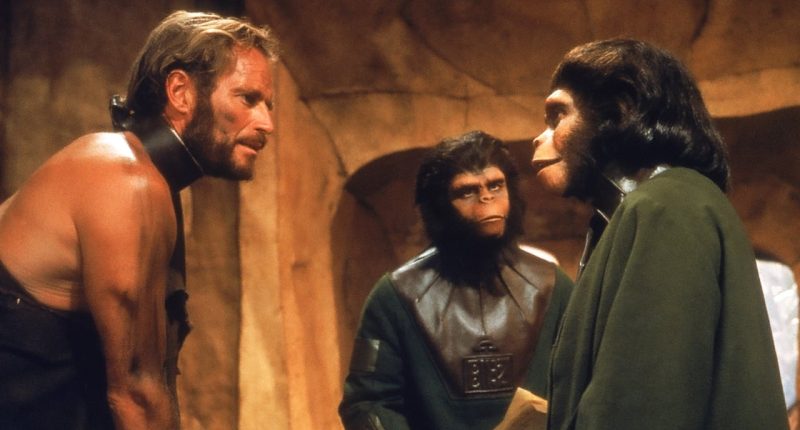
Few science‑fiction films have carved their place in history as decisively as Planet of the Apes (1968). Director Franklin J. Schaffner’s adaptation of Pierre Boulle’s novel became famous for its imaginative worldbuilding, unsettling atmosphere, and the commanding presence of Charlton Heston. But the true earthquake arrives only in the final minutes—an ending that still stuns audiences decades later and remains one of cinema’s most powerful twist conclusions.
The story of a man who believed he had landed on an alien world
The film follows astronaut Taylor, who survives a crash landing on what seems to be an unknown planet. He quickly discovers a society where intelligent apes rule—and humans have been stripped of dignity, freedom, and status. A man accustomed to making his own choices becomes prey, forced into a desperate fight for survival.
Along the way, Taylor encounters not only the cruelty of the system but also apes who dare to question it. Most notably, Zira and Cornelius emerge as rare allies, helping reveal early hints that this world’s past hides something far bigger than anyone will admit. By Taylor’s side is also Nova, a young woman who accompanies him as the story moves toward its fateful resolution.
The road to an ending that flips the entire film
In the final stretch, Taylor and Nova leave the ape city and the dangerous forbidden zone behind. The last surviving traces of evidence pointing to a long‑lost human civilization have been destroyed. Ahead lies a quiet shoreline—empty, still, seemingly meaningless. And yet it’s here that the film shifts from an adventurous sci‑fi journey into something closer to existential tragedy.
On the horizon, an odd shape rises from the sand near the sea. At first it’s only a vague silhouette. Taylor slows, dismounts, and approaches. As the image sharpens, it becomes clear this isn’t some random ruin. Half‑buried in the beach is the broken remnant of an enormous metal structure—an arm gripping a torch, contours unmistakable even in wreckage.
A moment of realization that takes your breath away
Taylor suddenly understands what the audience is realizing with him: the “alien planet” is Earth. Not a distant world at the edge of the universe, but the future of his own home. His journey through space hasn’t carried him into the unknown—it has delivered him into a time when human civilization has collapsed and another species has taken its place.
Before him lie the remains of the Statue of Liberty. The image is among the most famous in film history because it needs no elaborate explanation. One composition—ocean, shattered monument, and a man kneeling in the sand—communicates more than pages of dialogue. Taylor is crushed, and the audience is too, because every earlier scene suddenly snaps into a new, horrifying meaning.
A cry of despair as an indictment of humanity

Taylor’s reaction isn’t merely personal collapse. It’s a verdict on a civilization that destroyed itself. When he curses those who unleashed the catastrophe, he speaks for humanity as a whole. His words aren’t aimed only at the story’s past—they land on the viewer as a warning about pride, violence, and the self‑destructive hunger for power.
It isn’t just a shocking reveal—it’s the chilling suggestion that humanity’s greatest enemy may be itself.
Nova stands at a distance, unable to grasp the full scale of what has been found. The camera pulls back, framing the ruined statue in its tragic enormity. The silence of the coastline and the steady rhythm of the sea deepen the sense of finality. There is no easy fix here, no reset button, no way to rewind time—only the remains of a world that erased its own future.
Why this ending still works after all these decades
The brilliance of the finale is that it doesn’t play like a clever gimmick. It transforms everything the viewer has watched. The ruins in the forbidden zone, Dr. Zaius’s anxiety, and the ape society’s fear of human history all take on a new—and darker—logic. What once seemed like a strange alternate planet becomes the aftermath of a human-made disaster.
The film also inverts the relationship between humans and primates. Early on, Taylor sees the apes as a bizarre imitation of the civilization he knows. By the end, he understands that it was humanity that failed—succumbing to its own destructiveness and leaving room for another species to inherit the world. That idea still hits hard today because it isn’t just fantasy; it echoes real anxieties about where our future could lead.
Confident direction and an image you never forget
Planet of the Apes / Photo: 20th Century Fox
Franklin J. Schaffner delivers the final moments with remarkable restraint. He doesn’t overload the scene with explanation, doesn’t chase melodrama, and doesn’t dilute the impact with excessive literalness. He lets the image do the work—and that’s exactly why the ending lands like a blow. The viewer isn’t guided toward admiring the twist’s cleverness, but toward feeling disturbed by what it implies.
That’s why the conclusion of Planet of the Apes remains one of the most iconic in cinema history. It’s not simply an unexpected turn—it reframes the entire story as a tragic warning. For most of the film, Taylor searches for an answer to where he is. In the final moments, he learns the more important question was always what happened to his world. And that realization still sends a chill more than half a century later.
Sources: Allociné, Rotten Tomatoes, IMDb





Comments 0
No comments yet. Be the first to share your thoughts!
Leave a Comment