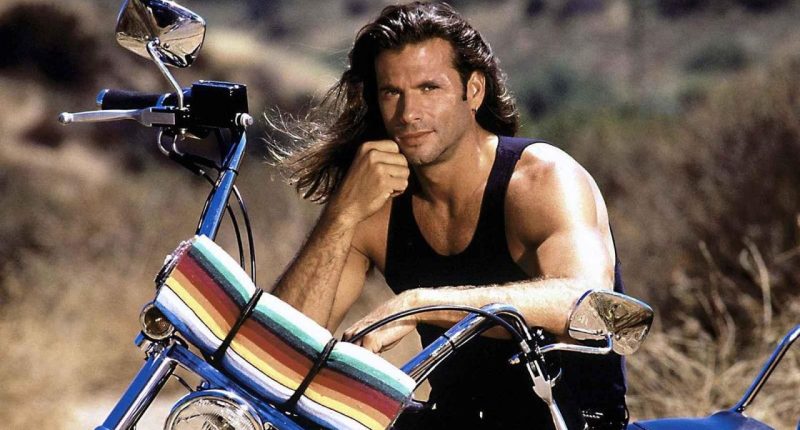
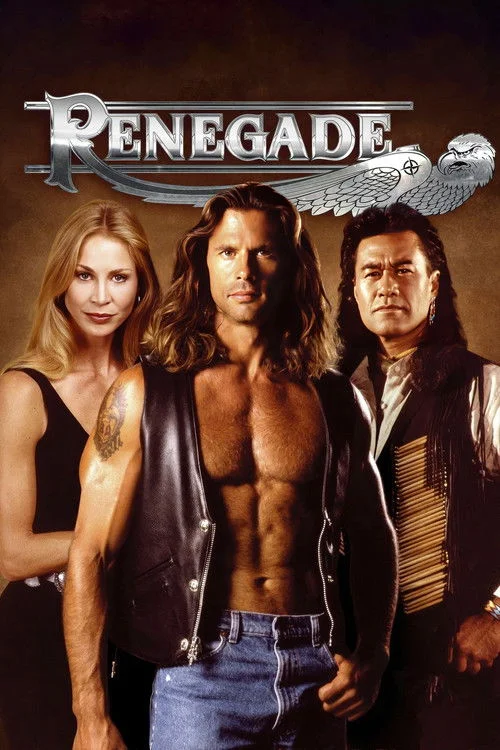
After a decade on Falcon Crest, Lorenzo Lamas landed the role that gave him a completely new TV identity. In the modern action-western Renegade, he played Reno Raines—a former police officer framed for murder who becomes a fugitive and, eventually, a bounty hunter. The show ran from 1992 to 1997 and, even if critics weren’t exactly won over, it found a large audience. In the end, it delivered 110 episodes and made its lead one of the most recognizable action images of its era.
The premise was simple but effective. Reno teams up with bounty hunter Bobby Sixkiller (Branscombe Richmond) while trying to stay one step ahead of the corrupt Marshal Dutch Dixon. The mix of biker aesthetics, constant escapes, small-town “western” motifs, and occasional melodrama created an easy-to-watch but distinctive ride.
Bon Jovi helped sell the show before it even existed
Creator Stephen J. Cannell wanted to capitalize on the booming market of syndicated series sold directly to local stations. To quickly communicate what Renegade should look and feel like, he cut together a high-energy sizzle reel set to Bon Jovi’s “Wanted Dead or Alive.” The presentation even included footage that never appeared in the finished series—yet it worked well enough to attract buyers.
That early montage ultimately became the backbone of the opening titles. The Bon Jovi track, however, had to go, replaced by a dramatic voiceover explaining that the hero was a good cop who committed an “unforgivable” act: testifying against corrupt colleagues.
Season one was still searching for its identity
Early on, Renegade was often described as The Fugitive on a motorcycle. The comparison wasn’t random: Reno frequently showed up as an outsider rolling into a small town and getting pulled into a local crisis. According to the creators—and Lamas himself—the early episodes sometimes lacked deeper character work and didn’t lean hard enough on the central storyline about the false accusation.
Lamas later said the show needed more human logic. Viewers shouldn’t just believe that Reno arrives, saves someone, and rides off—they should also believe how he got there, why he doesn’t simply leave the country, and why he keeps choosing a life of constant danger. Over time, the series found a better balance between standalone adventures and the larger arc of a man on the run.
The motorcycle was almost a co-star
Raines’ bike was one of the show’s defining images. The flame-painted machine was on-screen constantly, and production treated it almost like another actor. Multiple stunt bikes were used for dangerous sequences, while a polished “beauty” version was reserved for hero shots.
That emphasis on style also helped the series connect with Harley fans. Fittingly, the project’s early working title was reportedly Vincent Black—a nod both to Reno’s alias and to a famous motorcycle model.
Filming changed Lamas’ personal life, too
Production took place mostly near San Diego, which made it difficult for Lamas to see his children in Arizona. Travel was time-consuming, and visits disrupted school schedules. So he made a practical decision: he earned a pilot’s license, allowing him to fly in for weekends and spend more time with his family.
What began as a family solution turned into a lasting passion. Lamas later pursued aviation more seriously, including commercial helicopter flights over New York City.
The creator played the main villain
Stephen J. Cannell wasn’t only the architect of the series—he also portrayed Dutch Dixon, the relentless man hunting Reno. It’s not common for TV creators to step into a major recurring role, but Cannell embraced the opportunity, returning again and again as the show’s signature antagonist. Dixon functioned as a determined pursuer in the tradition of The Fugitive’s famous chaser.
In later recollections, multiple actors reportedly tested for the part, but Lamas is said to have suggested Cannell play it himself. The result was a villain with a strong screen presence and a clear “author’s stamp.”
A real-life marriage drama affected the cast
The series also featured Lamas’ then-wife, Kathleen Kinmont, as Cheyenne Phillips—Bobby Sixkiller’s sister, who formed a close bond with Reno. The casting wasn’t purely professional: Lamas worried that long stretches apart during production would strain their marriage, so he pushed for her to be part of the show.
After the couple divorced, the situation shifted. Their relationship deteriorated, and Lamas ultimately pushed for Kinmont to leave the series. Cheyenne then disappeared from the story without much explanation. In that sense, Renegade carried not only on-screen tension, but traces of real behind-the-scenes conflict.
Johnny Cash appeared—and Carl Weathers directed
One of the show’s most memorable guest stars was Johnny Cash. In a mid-’90s episode, he played a fugitive who leads Reno through a story structured like a twist on A Christmas Carol. The episode imagines what the world might look like if Reno had died years earlier and never became a man on the run.
A notable name also showed up behind the camera: Carl Weathers—best known as Apollo Creed—directed an episode in which Reno goes undercover as a male escort to expose a drug operation. It’s a good example of how freely the series blended action with pulpy, tongue-in-cheek scenarios.
A hidden nod in the credits—and an infamous wig
For all its loud style, Renegade still tucked a subtle visual joke into its opening. In one shot, Reno rides down a dusty road that forms the shape of a “Z”—a small tribute to Zorro, another outsider who rides in to help strangers.
Later, viewers noticed a less elegant change. In the final season, Lamas cut his hair shorter, which didn’t match Reno’s established look—so the show gave him a wig. Lamas later joked about it openly, calling it a pretty unfortunate choice. Still, it’s one of those odd details fans remember.
The long coat outlived the series
Along with the motorcycle and the muscle-bound hero image, Reno’s long coat became part of the show’s signature silhouette. In dusty California landscapes, it helped sell the modern-western vibe that defined the series. And that coat may have had the longest afterlife of all.
A similar coat later popped up in the comedy It’s Always Sunny in Philadelphia, where Mac wears it while claiming it makes him look like Lorenzo Lamas—and that women supposedly can’t resist. It’s proof that Renegade may not have been the critics’ darling, but it left a highly recognizable mark on TV pop culture.
Sources: Mental Floss, Filmozrouti, Wikipedia



Comments 0
No comments yet. Be the first to share your thoughts!
Leave a Comment