
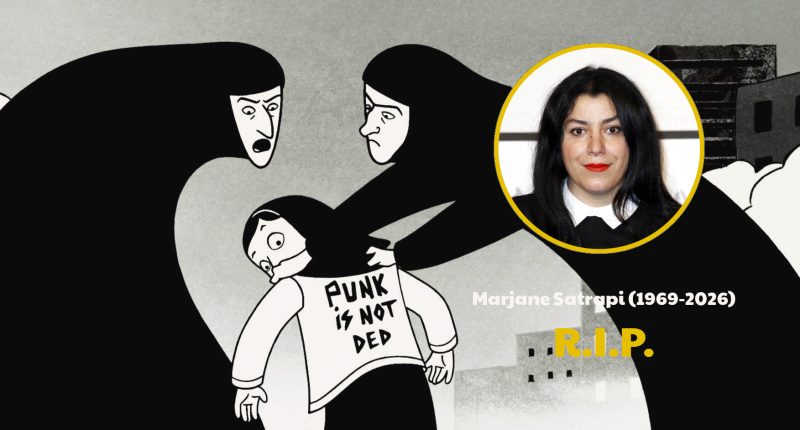
Marjane Satrapi, the Franco-Iranian director, illustrator, and writer best known worldwide for Persepolis, has died at the age of 56. Her passing marks the loss of an artist whose work resonated far beyond the borders of Iran or France—uniting autobiography, political courage, and a sharp, human sense of humor. Satrapi earned extraordinary recognition from audiences and critics alike, including an Academy Award nomination for Persepolis. News of her death prompted a particularly strong response in France, where she was widely regarded as one of the defining cultural figures of her generation.
Her family spoke of profound grief
According to statements shared by close friends and family, Satrapi died more than a year after the death of her husband, Mattias Ripa—described by those around her as the love of her life. Ripa, who worked as a producer, actor, and screenwriter, died on April 8, 2025. The announcement of Satrapi’s death was made public on June 3, and the words of those closest to her made clear how deeply the earlier personal loss had affected her.
Tributes from France and recognition of a lifetime of work
Satrapi’s death was also acknowledged by the office of French President Emmanuel Macron. In its statement, the presidency emphasized that her passing represents the loss of a major figure in French culture—an artist closely associated with the idea of freedom. French officials noted the universal reach of her work and the exceptional international respect it earned her.
Growing up in Iran, rebuilding life in France
Satrapi was raised in Tehran in an upper middle-class family. She was ten years old when Ayatollah Ruhollah Khomeini came to power in 1979. Her firsthand experience of Iran’s upheaval and the rise of an increasingly repressive system later became a defining force in her storytelling. Over time, Satrapi emerged as an outspoken critic of the Iranian government. She moved to France in 1994 and received French citizenship twelve years later.
Persepolis as a defining work
Her greatest fame came with Persepolis (2007), co-directed with Vincent Paronnaud. Adapted from her celebrated graphic novel, the animated film revisited her coming-of-age during the Iranian Revolution. It blended intimate confession with irony and an unflinching critique of life under religious authority. The film won the Jury Prize at Cannes and was later nominated for the Academy Award for Best Animated Feature.
Throughout her career, Satrapi repeatedly drew attention to the unequal status of women in Iran, insisting she never accepted the idea that her gender made her worth any less.
More films and a wide creative range
After Persepolis, Satrapi continued collaborating with Paronnaud on Chicken with Plums, which premiered in competition at the Venice Film Festival in 2011. The story follows a musician who loses his will to live after his instrument is destroyed. Satrapi later expanded further into live-action cinema, directing the crime comedy La Bande des Jotas, in which she also appeared alongside Mattias Ripa.
In 2019, she released Radioactive, a biographical drama about Marie Curie starring Rosamund Pike, set in late-19th-century Paris. Around the film’s release, Satrapi spoke candidly about women’s position in the film industry, arguing that female directors are often trusted less with big-budget projects despite being just as capable of handling them.
Her final film and an uncompromising civic stance
Satrapi’s last film was Dear Paris (2024), a black comedy set in the French capital, where several characters collide with the theme of death and, in doing so, rediscover the value of life. Even in her final years, she remained a prominent public voice on freedom, human rights, and Europe’s relationship with Iran.
She drew widespread attention last year when she refused to accept the Legion of Honour, France’s highest state decoration. She explained her decision as a protest against what she viewed as France’s approach to Iran. In an open letter to the Minister of Culture, she condemned what she called the hypocrisy of French diplomacy—arguing that while the children of Iranian oligarchs can live in France easily or even obtain citizenship, young opponents of the regime often face obstacles as basic as securing a visa.
An artist who fused personal experience with a universal message
Marjane Satrapi leaves behind a body of work that crossed languages, borders, and cultural divides. Her films and books combined intimate memory with political bravery and a powerful visual storytelling instinct. She spoke about oppression, identity, women’s strength, and exile in a way that was personal yet accessible—and unmistakably human. For that reason, she leaves more than a notable filmography: she leaves the imprint of an artist who refused to stay silent.
R.I.P.
Sources: Variety, France24




Comments 0
No comments yet. Be the first to share your thoughts!
Leave a Comment