
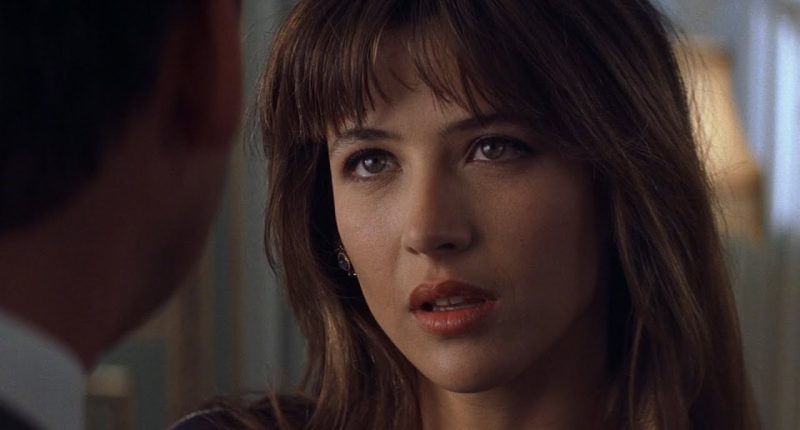
Sophie Marceau has been regarded for decades as one of the most distinctive figures in French cinema. On screen, she has always combined charm and naturalness with an unusual inner strength. Yet her story did not begin in comfort or privilege. She was born in Paris in 1966 as Sophie Danièle Sylvie Maupu into an ordinary family. Her father worked as a truck driver, her mother held jobs in retail and later in a brasserie. She spent her childhood in modest circumstances and, after her parents’ divorce, grew up with her father on the outskirts of Paris.
From a very young age she longed for greater independence and a better life. That desire led her to a children’s advertising agency—and from there to a life-changing film opportunity. Director Claude Pinoteau was searching for a lead actress for La Boum (The Party), and he chose fourteen-year-old Sophie. The film turned her into a star almost overnight.
La Boum opened the door to fame—and to her first major decision
She played a teenage girl navigating first love and family tensions. Audiences immediately embraced her, and the movie drew millions. During production she also adopted the stage name Marceau, chosen to keep the same initials as her birth surname. After the success of La Boum 2, she received the César Award for Most Promising Actress.
But success came with a price. Studio Gaumont tied her to an exclusive contract and expected her to remain primarily the face of light romantic roles. Marceau, however, refused to be merely a decorative figure in the industry. She wanted more demanding parts and the ability to steer her career herself. At just sixteen, she made an extraordinarily bold move: she bought herself out of the contract for one million francs—accepting serious financial risk to regain control.
With that decision, she made it clear that freedom and ownership of her own life mattered more to her than comfortable certainty.
From comedies to psychologically demanding roles
Once she had artistic independence, Marceau began choosing far more varied projects. She appeared in the large-scale drama Fort Saganne and in the popular comedy Happy Easter alongside Jean‑Paul Belmondo. A major influence on her next chapter was also her relationship with director Andrzej Żuławski, who was significantly older and became not only her partner but an important creative guide.
Under his influence, she moved toward more psychologically complex films and gradually left behind the “girl from La Boum” image. They lived together for seventeen years and had a child. Throughout that period, Marceau continued working steadily, building a reputation for handling both intimate dramas and stage roles. Theater brought her additional recognition, including a Molière Award for Best New Actress.
Hollywood, and an unforgettable Bond role
A major international breakthrough arrived in 1995 when Mel Gibson cast her in the historical epic Braveheart. Her role as Princess Isabelle introduced her to a wider audience and proved she could hold her own in English-language productions. The film won multiple Academy Awards, and her name became firmly established beyond France.
Another defining moment came with the Bond film The World Is Not Enough. Marceau didn’t play a conventional companion to Agent 007; instead, she portrayed the dangerous, intelligent Elektra King. That choice set her apart from many earlier Bond women and confirmed her ability to pair elegance with a darker, more complex edge.
Independent on screen—and off
Although she had the opportunity to fully expand her career in Hollywood, Marceau largely remained loyal to French filmmaking. Over time she also turned to directing and leaned toward more intimate projects. She cultivated a reputation as an artist who won’t be dictated to and who speaks her mind openly. That directness sometimes complicated relationships within the industry, but it also strengthened her image as a remarkably self-determined woman.
Her private life was frequently discussed as well, since her relationships were closely followed by the media. Still, she continued to project the same independence in her personal choices, refusing to conform to expectations and insisting on her own path. From 2007, Sophie Marceau formed a high-profile couple with Christopher Lambert. They lived together for seven years and also appeared together on screen.
Elegance, animal protection, and helping children
To this day, Sophie Marceau is associated with natural elegance and refined style. Beyond acting, she has also become strongly engaged in public-interest causes. She is a vocal opponent of blood sports, particularly the hunting of turtledoves and bullfighting, and has joined protests in defense of animals and nature.
She also supports children-focused charity work. As a patron of the Arc-en-Ciel organization, she helps socially disadvantaged children fulfill wishes and experience a fuller life. In doing so, she shows that her public role is not built only on fame and film history, but also on a willingness to use her influence for others.
Sophie Marceau remains a symbol of a woman who was willing to pay a high price for freedom, protected her own identity, and today uses her voice to stand up for those who are more vulnerable.
Sources: Elle, Telé Loisirs, Premiére


Comments 0
No comments yet. Be the first to share your thoughts!
Leave a Comment